📞 +91-8538070869✉ info@arukalinstruments.in
Sales & service: West Bengal • Guwahati, Assam
Home / Products / Ion Exchange Resin / Cation Resin
Cation Resin
Resin

Cation Resin

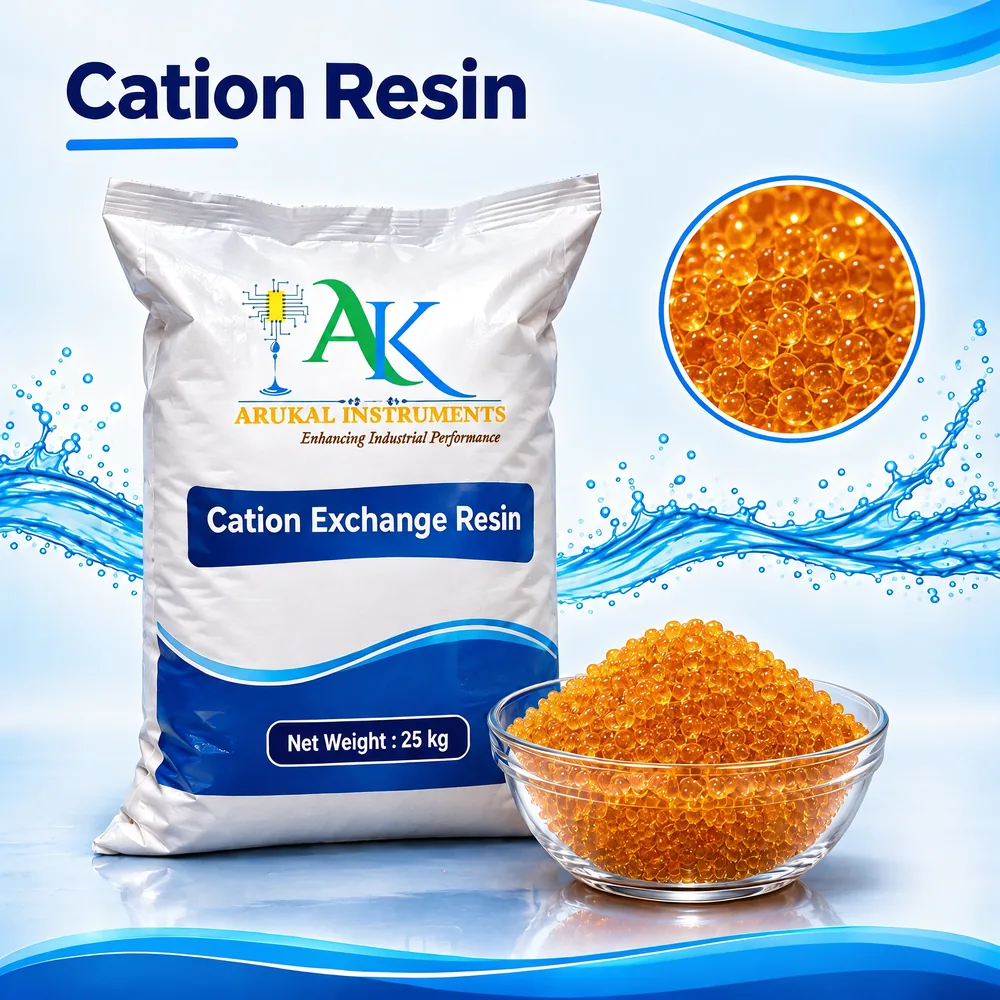
Strong acid cation exchange resin, hydrogen form

First stage of DM and mixed bed plants. Select, supply and support from Arukal Instruments, serving India and Nepal.

1.8 meq/ml minCapacity
Hydrogen, H+Ionic form
0.3 to 1.2 mmParticle size
120 °CMax temperature
Overview

What it does

Strong acid cation resin removes positively charged ions such as calcium, magnesium and sodium from water and gives back hydrogen ions in exchange. In hydrogen form it is the first stage of a de-ionising (DM) plant, with an anion resin after it.

Arukal supplies cation resin in 25 L bags for new DM plants, mixed bed units and refills, and helps you match the resin quantity to the vessel and the water analysis.

Cation Resin
1

Service

Water flows down through the bed and the resin swaps cations for hydrogen ions.

2

Exhaustion

When the resin is full of cations, the treated water quality starts to change.

3

Backwash

Upward water flow loosens the bed and clears dirt before regeneration.

4

Regenerate and rinse

Acid restores the resin to hydrogen form, then the bed is rinsed before service.

Features & benefits

Why choose Arukal Cation Resin

Strong acid resin

Sulphonic acid groups on a styrene divinylbenzene matrix.

Supplied in hydrogen form

Ready for the first stage of de-ionising.

Uniform beads

A 0.3 to 1.2 mm bead range with a low uniformity coefficient.

High temperature limit

Rated to 120 °C maximum operating temperature.

Full pH range

Works across a pH range of 0 to 14.

Resistant to reducing agents

Good resistance to reducing agents.

Data sheet

Characteristics

Strong acid cation exchange resin, hydrogen form.

Appearance
Golden yellow to brown beads
Matrix
Styrene divinylbenzene copolymer
Functional group
Sulphonic acid
Ionic form as supplied
Hydrogen, H+
Total exchange capacity
1.8 meq/ml, minimum
Moisture holding capacity
49 - 55 %
Shipping weight *
780 kg/m³ approximately
Particle size range
0.3 to 1.2 mm
> 1.2 mm
5.0 %, maximum
< 0.3 mm
1.0 %, maximum
Uniformity coefficient
1.7, maximum
Effective size
0.45 to 0.55 mm
Maximum operating temperature
120 °C
Operating pH range
0 to 14
Volume change
Na to H, 8 % approximately
Resistance to reducing agents
Good
Resistance to oxidizing agents
Generally good, chlorine should be absent

* Weight of resin, as supplied, occupying 1 m³ in a unit after backwashing and draining.

Applications

Where it is used

De-ionising (DM) plants
Two bed and multi bed de-ionisers
Mixed bed polishing units
Boiler feed water
Process water
Laboratory water
Selection guide

What we need to recommend the right resin

  • Raw water analysis (cations, alkalinity, TDS)
  • Treated water quality needed
  • Service flow and vessel size
  • Regeneration chemical available
  • Resin quantity or refill requirement
Capacity
1.8 meq/ml min
Ionic form
Hydrogen, H+
Particle size
0.3 to 1.2 mm
Max temperature
120 °C
Handling & care

Loading, use and care

  1. 1

    Load

    Fill the vessel with resin that is wet and rinse it before first use.

  2. 2

    Regenerate

    Regenerate on a schedule or by treated water quality, and rinse until the outlet is clean.

  3. 3

    Protect

    Keep chlorine and other oxidisers out of the feed water.

  4. 4

    Replace

    Top up or replace the resin when the capacity between regenerations falls.

Downloads

Data sheet and brochure

FAQ

Frequently asked questions

What comes after the cation resin?

An anion resin. Type-I or Type-II anion resin follows it in a de-ionising plant.

What form is it supplied in?

Hydrogen form.

What is the maximum operating temperature?

120 °C.

Does chlorine harm it?

The resin has generally good resistance to oxidising agents, but chlorine should be absent from the feed water.

Resin range

Other resins we supply

Need help choosing the right water treatment solution?

Request a Quote →